ACE Fleet vs. the AI Gateway Market: What Each Product Actually Covers
An honest, sourced comparison of ACE Fleet against LiteLLM, Portkey, Helicone, Cloudflare AI Gateway, OpenRouter, Vercel AI Gateway, NVIDIA Run:ai/KAI and SkyPilot — what each one owns, where the value props diverge, and when you should pick someone else.
The first question in almost every evaluation call is:
"How is this different from LiteLLM? We already have a gateway."
The honest answer: we operate on different rungs. AI gateways normalize APIs and route between external providers; ACE Fleet arbitrates across your entire compute estate—in-house GPUs, reserved instances, spot pools, and pay-as-you-go APIs.
More importantly, ACE Gateway provides far more than just full-stack integration across substrates. While most gateways treat traffic as simple pass-through and expect downstream teams to build their own in-house evaluation and regression pipelines, ACE delivers out-of-the-box quality control and performance regression monitoring alongside unit economics.
When engineering teams ask, "How do you ensure there is no production performance regression with caching, routing, and compaction in place?", ACE answers that end-to-end: coupling cost efficiency with continuous A/B regression testing, latency SLO enforcement, and counterfactual proof.
This post maps nine products across the AI infrastructure stack, highlights where value propositions genuinely diverge, and outlines when you should choose a specialist instead of us.
All competitor details reflect public documentation and announcements as of September 2026 (sources linked below).
1. The market is three rungs, not one list
Gateway comparisons often fall flat because they collapse three distinct architectural tiers into a single category:
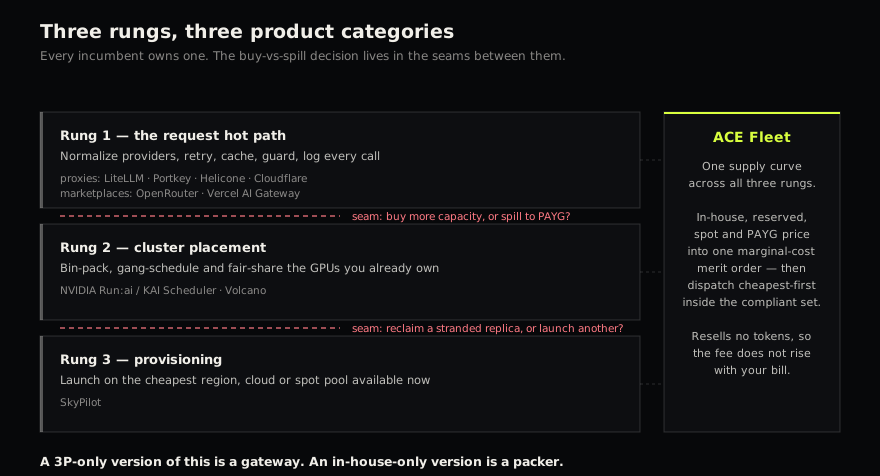
- Rung 1: The Request Hot Path (Proxies & Marketplaces)
- Self-directed proxies (LiteLLM, Portkey, Helicone, Cloudflare AI Gateway): Sit in front of your own provider accounts to handle retries, fallbacks, caching, guardrails, and logging.
- Inference marketplaces (OpenRouter, Vercel AI Gateway): Resell inference across hosted models behind a unified account and balance, dynamically routing between third-party model providers.
- Rung 2: Cluster Placement
- Bin-packs, gang-schedules, and fair-shares self-hosted GPU nodes (NVIDIA Run:ai, KAI Scheduler, Volcano). Focuses strictly on where inside my existing cluster a job should run.
- Rung 3: Provisioning
- Discovers the cheapest available cloud or spot instances at launch and automates preemption recovery (SkyPilot). Operates at cluster spin-up, not per-request.
The Problem: Expensive Decisions Live in the Seams
Each specialist excels on its own rung, but none cross the boundaries:
- A gateway routes across API keys, blind to an in-house H100 cluster idling at 50% utilization down the hall.
- A cluster scheduler packs local GPUs, unaware of external PTU commits or PAYG burst rates.
- A provisioning broker selects a cheap instance at launch, then hands off control.
ACE operates across all three seams—running a unified marginal-cost merit order across owned GPUs, reserved third-party blocks, spot instances, and PAYG APIs simultaneously. As detailed in Merit-order dispatch: a 3P-only version of this is a gateway, and an in-house-only version is a packer.
2. Coverage, side by side
Nine products mapped across seven core capabilities:
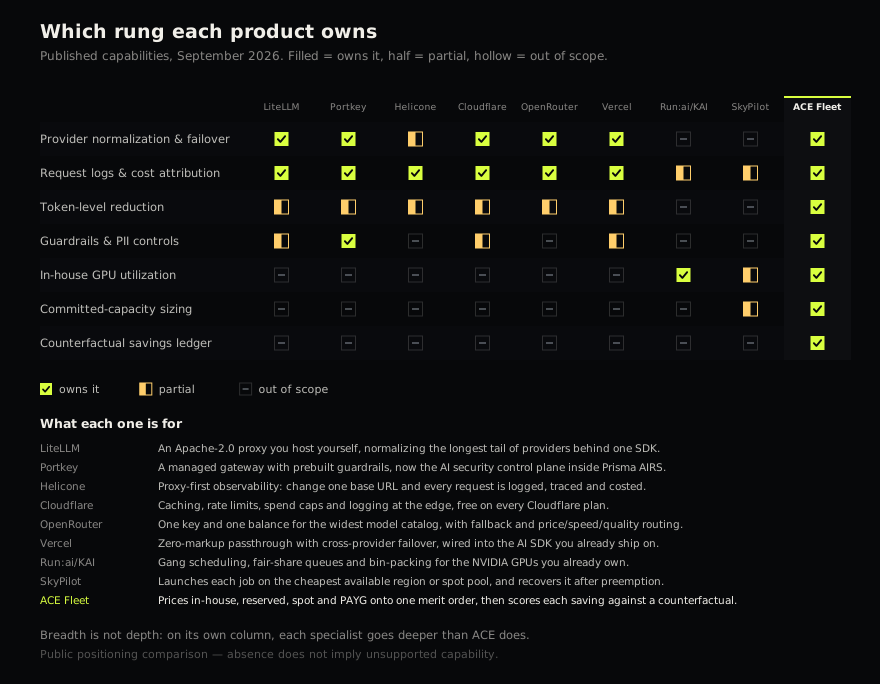
Breadth is not depth. On their home turf, specialists offer deeper vertical features than we do. Portkey provides more out-of-the-box guardrails. Cloudflare leverages an unmatched global edge network. KAI delivers deeper Kubernetes topology and gang scheduling. LiteLLM supports a broader tail of niche providers. OpenRouter maintains a larger model catalog, and Vercel offers tighter integration with the Next.js AI SDK.
Note on Market Evolution: Portkey was acquired by Palo Alto Networks (closed May 2026) and integrated into Prisma AIRS as an AI security control plane. If your primary evaluation criterion is enterprise security rather than infrastructure efficiency, Prisma AIRS is a compelling dedicated option.
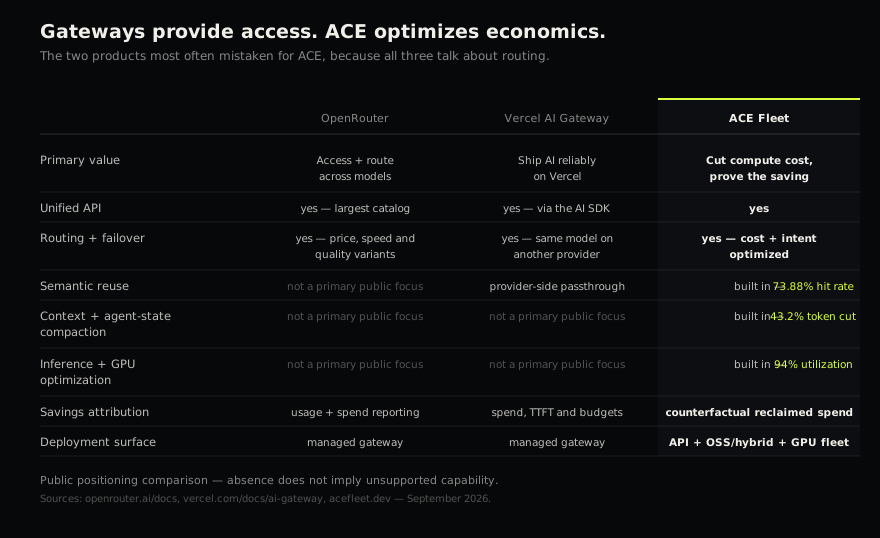
3. Gateways provide access. ACE optimizes economics.
Marketplaces and gateways are frequently confused with ACE because all three mention routing. However, they optimize fundamentally different objectives:
- Marketplaces optimize access: Ensuring model availability, low latency, and discovering the cheapest third-party host for a given model.
- ACE optimizes end-to-end compute economics: Determining whether a model call is required at all, compacting context to minimize transmitted tokens, and routing each request to the most cost-efficient substrate (owned vs. rented).
Two Key Distinctions
- Public positioning vs. capability: Marketplaces focus on provider connectivity and developer experience, offloading quality assurance and regression testing to downstream consumers. ACE is purpose-built for context compaction, semantic reuse, and cross-substrate arbitrage, backed by built-in regression monitoring.
- Deployment surface dictates utility: Managed gateways require zero operational overhead, making them ideal for pure third-party API setups. ACE is built for heterogeneous estates where workloads span VPCs, local clusters, and external APIs.
4. Where value propositions diverge
Four structural differences distinguish ACE from traditional gateways:
4.1 Single Supply Curve Across All Substrates
Traditional gateways treat all targets as uniform external endpoints. They are structurally blind to marginal cost.
ACE maps every available execution tier to a dispatch merit order:
- In-House GPUs (Baseload): Sunk infrastructure cost; marginal cost is near-zero up to cluster capacity.
- Reserved Third-Party Capacity: Sunk cost up to committed throughput.
- Spot Instances: Inexpensive, interruptible capacity.
- PAYG APIs (Peakers): Infinite elasticity, zero commitment, but highest per-token unit cost.
ACE accounts for the stutter knee—the utilization threshold where queuing delays degrade latency SLOs. Dispatch fills tiers up to their latency-optimal threshold rather than naive 100% saturation.
4.2 Out-of-the-Box Quality Control & Performance Regression Monitoring
Most gateways treat traffic as a transparent proxy. They leave quality assurance, A/B evaluations, and regression monitoring entirely to downstream teams. If you enable semantic caching, dynamic model routing, or prompt compaction in a standard proxy, your team must build bespoke evaluation harnesses and offline benchmarks to ensure accuracy did not degrade.
ACE provides quality control and regression monitoring out of the box:
- Continuous Latency & Quality Telemetry: Every optimized request is scored against latency distributions (P50/P95/P99 TTFT and inter-token latency) and output quality metrics.
- Automated Shadow-Mode A/B Testing: Evaluate optimized variants (compacted prompts, routed SLMs, cached responses) against unoptimized baselines in real time without impacting live user traffic.
- Canary Guardrails & Auto-Revert: Optimizations roll out through staged canary ladders. If latency drifts or model accuracy dips below guardrail thresholds, traffic automatically falls back to baseline.
- Dual-Ledger Visibility: Dashboards display unit economics alongside real-time quality and latency metrics, ensuring cost reductions never hide silent regressions.
4.3 Decomposed, Counterfactual Verification
Most FinOps tools display aggregate spend without proving incremental ROI. ACE disaggregates each optimization lever into an isolated benchmark with an explicit counterfactual baseline:
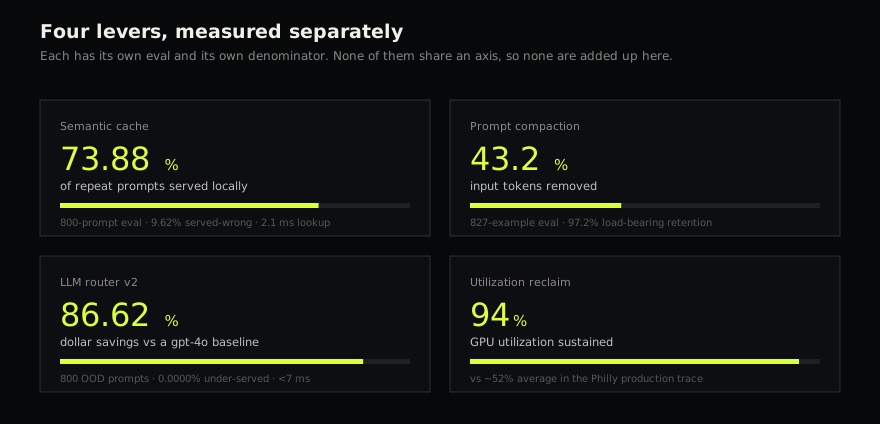
Rather than blending these into an unprovable single number, each lever is evaluated independently against verified traces:
- Semantic cache: 73.88% repeat query reuse with 2.1 ms lookup.
- Prompt compaction: 43.2% input token reduction at 97.2% retention.
- LLM router v2: 86.62% dollar savings vs. GPT-4o with zero under-served queries.
- Utilization headroom: 94% sustained GPU utilization vs. a ~52% production baseline.
Reclaimed capacity is verified through goodput-at-risk tracking—guaranteeing that de-allocated instances do not jeopardize active SLAs.
4.4 Constraint-First Feasibility Filtering
Cost optimization should never violate compliance or latency bounds. ACE applies a strict capability and data residency filter prior to cost optimization:
- If no compliant endpoint is available, the request fails fast or raises an alert rather than spilling to an unvetted provider.
- Telemetry uses salted pseudonymization; raw customer identifiers never traverse customer VPC boundaries.
- Optimization follows an audit-first progression: passive observation, recommendation with notification, and automated enactment.
5. When you should pick someone else
Specialized tools excel at specific scopes:
- Pick Cloudflare AI Gateway if you want zero-cost edge caching, rate limiting, and analytics on Cloudflare's global network for API-only workloads.
- Pick LiteLLM if you need a self-hosted, Apache-2.0 proxy to normalize dozens of distinct provider APIs behind an OpenAI-compatible interface.
- Pick Portkey / Prisma AIRS if your chief requirement is enterprise security governance, prompt guardrails, and compliance within the Palo Alto Networks ecosystem.
- Pick OpenRouter if you want frictionless access to hundreds of public models using a single API key and shared credit balance.
- Pick Vercel AI Gateway if your application is built on Next.js and the Vercel AI SDK, and you want automatic provider failover with zero markup.
- Pick Helicone if you require lightweight, drop-in observability and request tracing via a simple base-URL modification.
- Pick NVIDIA Run:ai / KAI if your compute consists entirely of on-premise Kubernetes GPU clusters needing fair-share gang scheduling.
- Pick SkyPilot if you run asynchronous batch training and spot-instance jobs across multi-cloud infrastructure.
Consider ACE when either (or both) of the following apply:
You optimize for end-to-end cost efficiency and are unsatisfied with your current gateway's actual savings and performance improvements. Most gateways operate as thin pass-through proxies that report spend without aggressively reducing token waste or protecting production quality. ACE Gateway delivers full unit economics and FinOps optimization with complete performance control and visibility. Rather than forcing downstream teams to build bespoke in-house evaluation harnesses and A/B testing pipelines just to safely enable caching or routing, ACE answers "how do you ensure there is no production performance regression?" out of the box—coupling continuous cost reduction with real-time quality control, strict latency SLOs, canary verification, and automated rollback.
— and / or —
You operate multiple deployment tech stacks across heterogeneous substrates. If your estate combines multiple commercial API providers (such as Azure OpenAI and Fireworks AI), reserved throughput blocks, spot capacity, or in-house GPU clusters, traditional gateways are structurally blind to marginal cost. ACE runs a unified merit order across every substrate you own and rent—automatically deciding which tier should have served each request and proving what it would have cost if it had gone the other way.
6. How to run an objective bake-off
To evaluate these architectures against your own production traffic:
- Establish a decomposed baseline: Audit 30 days of production traffic across cache hits, prompt tokens, completion tokens, and peak queue latency.
- Deploy candidates in shadow mode: Route duplicate live traffic to candidates without putting them on the critical response path.
- Verify out-of-the-box quality & regression guards: Check whether the gateway provides built-in A/B regression testing and quality monitoring, or if your team must build bespoke evaluation harnesses to detect drift in TTFT, task completion, or semantic accuracy.
- Require isolated denominators: Disregard blended savings claims; demand per-lever benchmarks with documented baselines.
- Stress test edge cases: Verify how each tool behaves under empty feasible sets, cache near-misses, and provider outages (see our reviews on gateway guardrails and storm guards).
Sources
Competitor capabilities are drawn from public documentation and official announcements as of September 2026:
- LiteLLM — routing & load balancing, AI gateway / proxy docs
- Portkey — feature comparison, cost management
- Palo Alto Networks — intent to acquire Portkey, acquisition completed
- Helicone — repository and license, cost tracking guide
- Cloudflare AI Gateway — overview, dynamic routing
- OpenRouter — FAQ and BYOK allowances, provider routing
- Vercel AI Gateway — AI Gateway docs, provider routing
- NVIDIA Run:ai / KAI Scheduler — NVIDIA open-sources the Run:ai scheduler, NVIDIA Run:ai product page
- SkyPilot — documentation, auto-provisioning and failover
ACE figures reflect published scorecards linked inline above.