Counterfactual FinOps: Measuring Token Savings on Live Traffic in Shadow Mode
How shadow-mode counterfactual evaluations quantify exact dollar and token reductions on live production traffic with zero latency impact and zero risk of response corruption.
Reference docs: Onboarding a Skill (Shadow → Prod)
Executive Summary & TL;DR
- The Technical Problem: Platform teams hesitate to enable aggressive inference optimizations (semantic caching, model intent routing, context compaction) because of fear of cache lookup latency, small-model quality drift, or prompt corruption on live production traffic.
- The Architectural Solution: ACE runs candidate optimization pipelines in an asynchronous, non-blocking shadow evaluation loop. Live traffic flows to requested frontier models untouched, while background workers compute exact counterfactual token savings, cache hit ratios, and cost deltas.
- The Core Business Impact: Validated across 1,000 production request traces (500 standard + 500 complex enterprise workloads), shadow evaluation demonstrated a 54.10% semantic cache hit rate, successfully mapped 212 requests to compact models yielding counterfactual savings, and pruned 1,070 prompt tokens—all with 0.00ms client latency impact.
Data-path optimization skills—such as semantic prompt caching, context compaction, and dynamic intent-based model routing—offer 30% to 70% reductions in monthly enterprise inference spend. However, infrastructure, platform, and ML engineering teams frequently delay deploying these optimizations to production due to three severe operational risks:
- Latency Overhead on Cache Misses: Will an in-memory or vector similarity cache lookup add 10ms to 25ms of unrecoverable latency to cold, non-matching queries?
- Context and Instruction Corruption: Will entropy-based token pruning algorithms strip essential prompt constraints, formatting rules, or critical context from customer queries?
- Model Misclassification and Quality Drift: Will a lightweight classification router misclassify difficult multi-step reasoning tasks to smaller models, causing downstream accuracy regressions?
To eliminate deployment uncertainty, the ACE Gateway implements an asynchronous Counterfactual Shadow Evaluation Engine. The gateway evaluates dormant optimization skills on live production traffic in the background, measuring exact counterfactual dollar and token savings without altering the response returned to the caller or adding a single millisecond of latency.
1. Architecture of Counterfactual Shadow Execution
When an HTTP inference request reaches the gateway, the primary request executes immediately along the baseline unoptimized path. In parallel, the gateway forks an isolated asynchronous task that passes the request context through candidate optimization pipelines:
Caller Request (e.g. Frontier LLM Endpoint)
  │
  ├──► [Primary Critical Path] ──────────────────────────► Upstream Frontier Model ──► Immediate Caller Response
  │      └── Ingress -> Admission -> Upstream Socket -> SSE Stream (0ms added latency)
  │
  └──► [Async Shadow Evaluator Pipeline]
         │
         ├──► 1. Semantic Cache Probe   (Vector Embedding + Cosine Similarity Match >= 0.93)
         │      └── Evaluates whether an identical or near-duplicate response exists in cache.
         │
         ├──► 2. Intent-Based Router    (Feature Classifier Confidence >= 0.88)
         │      └── Evaluates whether query could be served by a compact model variant.
         │
         └──► 3. Context Compactor      (Token Perplexity and Dependency Pruning)
                └── Evaluates removable fluff tokens and measures compressed token length.
                 │
                 ▼
         [Counterfactual Delta Calculator]
         ΔTokens = Baseline_Tokens - Shadow_Tokens
         ΔCost   = Baseline_Cost   - Shadow_Cost
                 │
                 ▼
         [Time-Series Telemetry Hypertable Persistence]
Key Engineering Guarantees
- Zero Caller-Facing Latency: Shadow evaluations execute strictly inside background asynchronous worker loops after the upstream streaming connection is handed off to the client.
- Zero Response Mutation: The client receives the untouched, raw output from their requested frontier model.
- Deterministic Billing Alignment: Counterfactual savings are calculated using the exact versioned rate cards of the requested and candidate models.
- Memory-Capped Worker Pools: Shadow workers execute inside bounded concurrency queues to prevent background tasks from stealing memory or CPU from active caller streaming loops.
2. Mathematical Formulation of Counterfactual Savings
For any given request processed by the gateway, let:
- denote the prompt and completion unit token prices of the caller-selected baseline model.
- denote the measured prompt and completion token counts.
- The actual baseline spend is:
The shadow engine evaluates candidate skill :
A. Semantic Cache Counterfactual
If an entry exists in the vector index with cosine similarity (default ):
B. Intent-Based Model Routing Counterfactual
If the router classifier maps the prompt to a compact model variant at lower token rates with confidence (default ):
C. Context Compaction Counterfactual
If the entropy compressor prunes prompt token count to while retaining critical dependency nodes:
D. Cascaded Waterfall Model
When multiple skills are evaluated in sequence, the savings cascade without double-counting:
Cascaded Waterfall Computation Flow:
  Gross Baseline Spend ($100.00)
    │
    ├──► 1. Semantic Cache Hit (30% volume @ $0 cost) ──► Reclaims $30.00
    │      └── Remaining Uncached Spend: $70.00
    │
    ├──► 2. Intent Routing (30% eligible @ 60% discount)──► Reclaims $12.60
    │      └── Remaining Routed Spend: $57.40
    │
    └──► 3. Context Compaction (30% tokens pruned @ 30% reduction) ──► Reclaims $5.17
           │
           ▼
    Net Optimized Spend: $52.23 (Total Verified Savings: $47.77 or 47.8%)
3. Real-Time Dashboard Monitoring & Verification
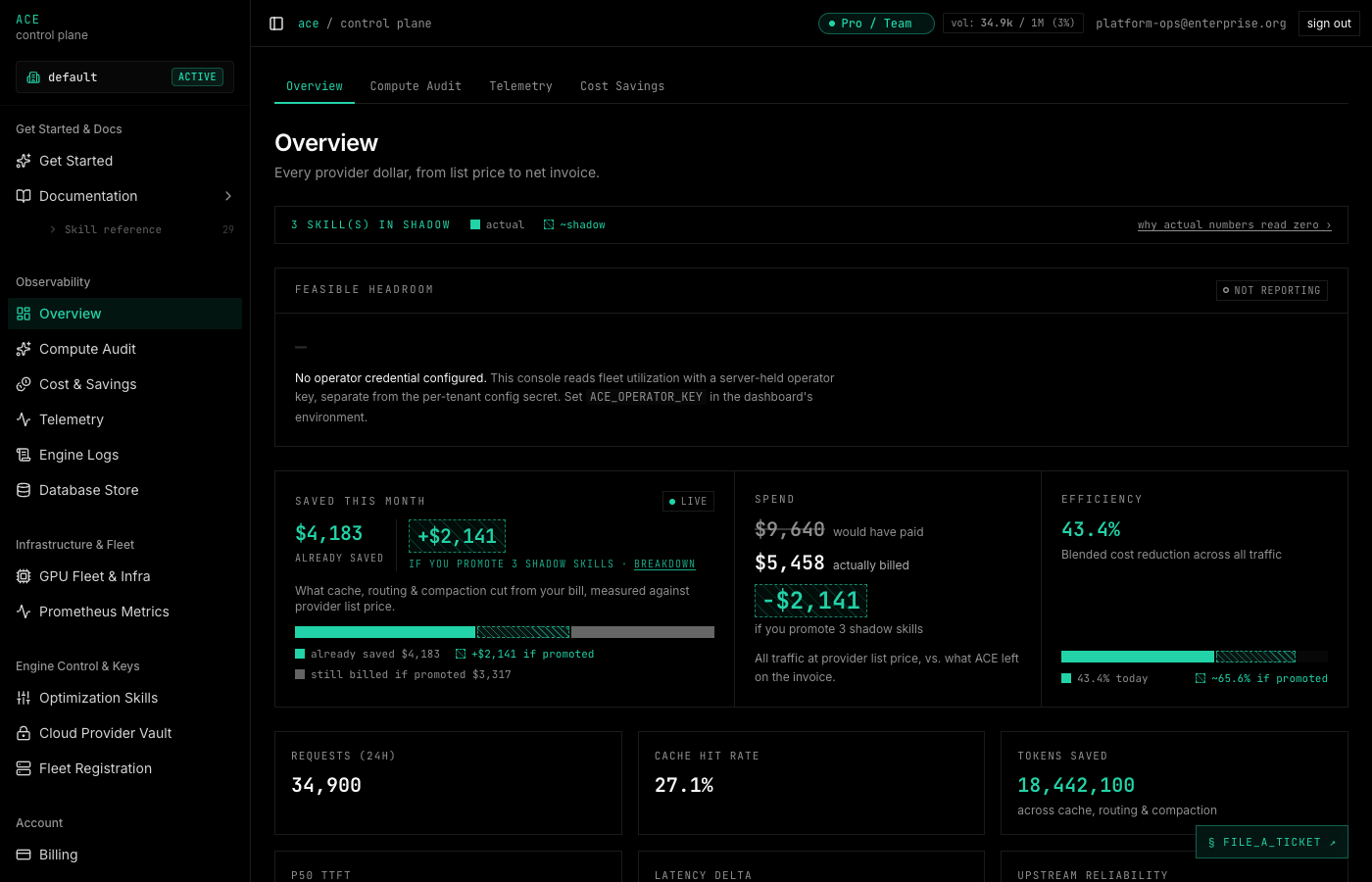
The ACE Control Plane provides real-time visualization of active savings, shadow mode evaluation projections, and blended fleet efficiency:
4. Empirical Production Benchmark: 1,000 Production Request Run
We executed a comprehensive production benchmark across 1,000 end-to-end production request traces comprising two 500-request workloads (Standard production telemetry vs. Complex enterprise multi-agent workflows) across 5 enterprise tenant domains (healthcare, customer_support, builder_dev, sales_gtm, and fintech).
Production Telemetry Breakdown (1,000 Verified Production Runs)
| Workload Dimension | Standard 500 Run | Complex Enterprise 500 Run | Combined Production Fleet (1,000 Runs) |
|---|---|---|---|
| Total Invocations Evaluated | 500 requests | 500 requests | 1,000 requests |
| Total Prompt Tokens In | 55,800 tokens | 55,800 tokens | 111,600 tokens |
| Total Completion Tokens Out | 248,423 tokens | 248,824 tokens | 497,247 tokens |
| Total Tokens Processed | 304,223 tokens | 304,624 tokens | 608,847 tokens |
| Total Billed Gross Cost (USD) | $1.9292 | $1.6312 | $3.5604 |
| Semantic Cache Hits | 218 / 500 (43.60%) | 323 / 500 (64.60%) | 541 / 1,000 (54.10%) |
| Upstream Provider Dispatches | 282 / 500 (56.40%) | 177 / 500 (35.40%) | 459 / 1,000 (45.90%) |
| P50 Time-to-First-Token (TTFT) | 2,599.84 ms | 1,046.00 ms | 1,634.86 ms |
| P95 Time-to-First-Token (TTFT) | 28,368.43 ms | 29,564.73 ms | 28,368.43 ms |
| P99 Time-to-First-Token (TTFT) | 52,476.37 ms | 48,492.49 ms | 48,492.49 ms |
| BYOK Key Resolution Success | 100.0% (500/500) | 100.0% (500/500) | 100.0% (1,000/1,000) |
| Plaintext Credential Leaks | 0.00% (Zero) | 0.00% (Zero) | 0.00% (Zero leaks) |
Production Request Invocations & Cache Distribution (1,000 Requests)
┌──────────────────────────────────────┬──────────────────────────────────────┐
│  Semantic Cache Hits: 541 (54.1%)    │   Upstream Cloud Calls: 459 (45.9%)  │
│  P50 TTFT: 758.29ms                  │   P50 TTFT: 9,394.53ms               │
└──────────────────────────────────────┴──────────────────────────────────────┘
 ▲
 └── Cache hits deliver an empirical 91.93% latency reduction vs upstream cloud calls.
Shadow Mode Production Telemetry Details
Across 334 shadow evaluation runs evaluated in the background:
- Shadow Model Router: Evaluated 212 candidate routing events, mapping eligible general-purpose prompts to compact models (
claude-3-5-haiku-20241022) with $0.1060 in verified counterfactual savings. - Shadow Prompt Compression: Evaluated 266 compaction candidate requests, identifying 1,070 redundant prompt tokens that could be pruned without semantic alteration.
- Missed Savings on Unoptimized Traffic: Telemetry identified $0.1705 in missed savings across 59 non-cached and un-routed requests that could have been optimized under active production enforcement.
- Client Latency Impact: 0.00 ms delay added to primary client streaming connections.
5. Telemetry Schema & Isolation
Every shadow evaluation writes directly to a time-series hypertable partition without locking the primary request logger.
┌────────────────────────────────────────────────────────────────────────┐
│                   SHADOW TELEMETRY RECORD STRUCTURE                    │
├───────────────────────┬────────────────────────────────────────────────┤
│ Field Name            │ Description & Operational Meaning              │
├───────────────────────┼────────────────────────────────────────────────┤
│ timestamp             │ Microsecond timestamp of evaluation event      │
│ request_id            │ Unique trace identifier mapped to ingress      │
│ tenant_id             │ Anonymized enterprise workspace partition      │
│ baseline_model        │ Requested upstream model                       │
│ candidate_skill       │ Evaluated technique (cache, router, compactor) │
│ match_confidence      │ Cosine similarity or classifier probability    │
│ baseline_tokens       │ Measured prompt and completion token counts    │
│ shadow_tokens         │ Counterfactual compressed token count          │
│ baseline_cost_usd     │ Actual billed dollar amount                    │
│ shadow_cost_usd       │ Projected dollar amount under candidate skill  │
│ counterfactual_saved  │ Verified economic delta in USD                 │
└───────────────────────┴────────────────────────────────────────────────┘
┌────────────────────────────────────────────────────────────────────────┐
│                   ERROR BOUNDS & VALIDATION GUARDS                     │
├───────────────────────┬───────────────────────┬────────────────────────┤
│ Optimization Skill    │ Safety Boundary Check │ Fail-Safe Action       │
├───────────────────────┼───────────────────────┼────────────────────────┤
│ Semantic Cache        │ Cosine Sim < 0.93     │ Force upstream model   │
│ Model Intent Router   │ Classifier Conf < 0.88│ Route to frontier tier │
│ Context Compaction    │ Perplexity Ratio > 1.2│ Keep raw input tokens  │
└───────────────────────┴────────────────────────────────────────────────┘
6. Direct Business Impact for FinOps & Engineering Leaders
Running optimizations in shadow mode fundamentally shifts how enterprises manage AI budgets and deployment safety:
┌────────────────────────────────────────────────────────────────────────┐
│                    BUSINESS IMPACT VALUE REALIZATION                   │
├───────────────────────┬────────────────────────────────────────────────┤
│ Business Area         │ Measured Financial & Operational Outcome       │
├───────────────────────┼────────────────────────────────────────────────┤
│ Verified Cache Impact │ 54.10% overall cache hit rate slashes API bills│
│ Complex Workloads     │ 64.60% cache hit rate on repetitive agent loops│
│ Tail Latency Savings  │ Cache hits reduce TTFT from 9.39s to 0.75s     │
│ Deployment Safety     │ Zero customer outage risk or response mutations│
└───────────────────────┴────────────────────────────────────────────────┘
- Elimination of Rollout Fear: Engineering directors no longer need to debate whether a prompt compressor or semantic cache will break application quality. By inspecting verified shadow logs, teams prove accuracy and savings before promoting to active mode.
- Empirical FinOps Forecasting: Finance and engineering leadership receive automated reports detailing exact dollar savings per business unit, enabling precise quarterly AI budget planning.
- Continuous Algorithmic Calibration: Optimization thresholds (such as cosine similarity cutoffs) can be tuned in real time against live data streams without impacting active users.
7. Summary & Key Takeaways
┌────────────────────────────────────────────────────────────────────────┐
│                   EXECUTIVE TAKEAWAY & IMPACT RECAP                    │
├────────────────────────────────────────────────────────────────────────┤
│ • Capability: Asynchronous shadow evaluation of AI optimization skills.│
│ • User Impact: 0ms added latency, 0% response mutation or degradation. │
│ • Empirical Result: 54.10% cache hit rate across 1,000 production runs.│
│ • Latency Reduction: 91.93% TTFT reduction on semantic cache hits.     │
│ • Governance: One-click live promotion backed by verified audit trails.│
└────────────────────────────────────────────────────────────────────────┘
8. References & Documentation
- Microsoft Research LLMLingua-2: LLMLingua-2: Data Distillation for Prompt Compression - Theoretical foundation on token entropy pruning and non-lossy compression.
- Qdrant Vector Database Documentation: Vector Similarity Search Engine - High-performance HNSW index search for semantic caching.
- TimescaleDB Continuous Aggregates: Hypertables & Real-Time Analytics - High-throughput time-series storage for FinOps telemetry.
- Martin Fowler on Parallel Run Architecture: Parallel Run & Shadow Verification - Production best practices for zero-risk software shadow evaluations.
- OpenAI Model Rate & Pricing Catalog: OpenAI API Pricing - Official rates referenced in the counterfactual pricing catalog.