Zero-Risk AI Gateway Rollouts: Announcing Embedded Canaries and Auto-Revert
How ACE guarantees zero system performance and reliability regressions on live traffic by embedding fractional canary partitioning and automated circuit-breaker rollbacks into all skill launches.
The Central Question: "How Do You Make Sure There Is No Performance Regression?"
When platform and AI infrastructure teams consider enabling data-path optimization skills—such as prompt compaction, semantic caching, dynamic model routing, PII redaction, or prompt injection filters—they invariably face one fundamental question:
"How do you guarantee that turning on an optimization skill does not cause a performance regression in production?"
In modern Generative AI systems, "performance regression" manifests in two distinct dimensions:
┌─────────────────────────────────────────────────────────────────────────────────────────────────┐
│                    THE TWO DIMENSIONS OF GENAI PERFORMANCE REGRESSIONS                          │
├──────────────────────────────────────────────────┬──────────────────────────────────────────────┤
│ 1. System Performance, Reliability & Errors      │ 2. ML Quality, User Experience & Task Time   │
│    • Upstream 5xx/429 spikes & network timeouts  │    • Subtly degraded output reasoning        │
│    • Gateway CPU/memory latency overhead         │    • Broken code generation / JSON schemas   │
│    • Internal filter stalls & fail-open events   │    • Longer time to solve user/agent tasks   │
│    • Breaking client streaming connections       │    • Immediate client re-prompting loops     │
├──────────────────────────────────────────────────┼──────────────────────────────────────────────┤
│    SOLVED BY: Embedded Canaries & Auto-Revert   │    SOLVED BY: Dual-Axis Scorecards & Goodput │
│    (This Announcement)                           │    (See Companion Deep-Dive)                 │
└──────────────────────────────────────────────────┴──────────────────────────────────────────────┘
Today, we are announcing our architectural solution to Dimension 1: System Performance, Reliability, and Errors: Embedded Fractional Canaries and Automated Circuit Breakers built directly into every data-path skill in the ACE Gateway.
1. Why Binary Toggles Fail for System Reliability
In traditional AI gateways and reverse proxies, activating an optimization feature is an all-or-nothing gamble:
Traditional Gateway: Binary "All-or-Nothing" Rollout
[ Developer Enables Skill ] ──► 100% of Production Traffic Impacted
                                      │
                                      ▼
                        [ Edge Case / Upstream 5xx Surge ]
                                      │
                                      ▼
                          Full Production Outage / Error Spike
                          15-45 min Mean-Time-To-Detect (MTTD)
                          Manual Dashboard Rollback Required
The Three System Reliability Failure Modes:
- Upstream Provider Error Cascades: If prompt compaction alters an unexpected nested JSON field, or a router dispatches to an overloaded provider endpoint, upstream providers return immediate HTTP 400, 429, or 503 errors across 100% of tenant traffic.
- Gateway Processing Overhead: An un-canaried transformer compactor or regex filter can introduce high P99 CPU latency spikes, bloating Time-To-First-Token (TTFT) and stalling client HTTP streams.
- Internal Filter Failures & Stalls: When an ONNX runtime arena exhausts allocated memory or hits execution timeouts, naive proxies drop connections instead of safely falling open.
2. The Solution: The Extended 5-State Skill Lifecycle
To guarantee absolute system safety, ACE extends skill state management from binary switches into a deterministic 5-state lifecycle engine:
stateDiagram-v2
    [*] --> Off
    Off --> Shadow: 1. Counterfactual Observation (0 client impact)
    Shadow --> Canary: 2. Real Fractional Traffic (e.g. canary:10%)
    Canary --> Prod: 3. Full Production Rollout (100%)
    Canary --> RolledBack: Automated Circuit Breaker / Manual Revert
    Prod --> RolledBack: Safety Floor Violation / Incident Trigger
    RolledBack --> Shadow: Post-Incident Diagnosis
    RolledBack --> Off: Complete Deactivation
Lifecycle States:
off: The filter module is completely bypassed with zero CPU or memory penalty.shadow: The skill evaluates prompts counterfactually in the background with zero caller-facing latency or output mutation.canary:N%: A deterministic percentage (, default ) of live requests executes the skill in treatment mode, while the remaining serves as the concurrent control baseline.prod: The skill operates actively across 100% of production traffic for the designated API key.rolled_back: A quarantined safety state triggered automatically by circuit-breaker invariants or manually by an operator.
3. Stateless Deterministic Request Partitioning & Agent Session Stickiness
To prevent adding database roundtrips to the critical request path, ACE implements stateless, deterministic hashing:
                   Incoming Client Request
                              │
               [ dev_key_id + request_id / session_id ]
                              │
                    MurmurHash3 / MD5 (32-bit)
                              │
                        bucket = hash % 100
                              │
              ┌───────────────┴───────────────┐
              ▼                               ▼
       bucket < N                        bucket >= N
  ┌───────────────────────┐       ┌───────────────────────┐
  │   CANARY TREATMENT    │       │    CANARY CONTROL     │
  │ (Active Transformation│       │ (Baseline Passthrough/│
  │   & Optimization)     │       │     Shadow Logging)   │
  └───────────────────────┘       └───────────────────────┘
Zero Coordination Overhead
Each gateway node computes the bucket assignment independently:
- (active skill execution).
- (unmodified baseline execution).
Multi-Turn Agent Session Stickiness
For autonomous coding agents (Cline, Hermes, Claude Code), splitting consecutive turns of a conversation between treatment and control breaks session context. When a request includes a session_id, ACE hashes the session_id:
This guarantees that all conversation turns within a multi-step agent trajectory stay on the same branch.
4. Automated Circuit Breakers & Instant Auto-Revert
The canary system is backed by a real-time statistical anomaly monitor that inspects a sliding 15-minute window ( requests) for system regressions:
               ┌──────────────────────────────────────────────┐
               │    Sliding 15-Minute Scorecard Buffer        │
               └──────────────────────┬───────────────────────┘
                                      │
                                      ▼
                      [ Evaluate Safety Invariants ]
                                      │
     ┌────────────────────────────────┼───────────────────────────────┐
     ▼                                ▼                               ▼
Fail-Open Rate > 1.0%?     Upstream Error Delta > +5pp?   Client Retries Surge > 2x?
     │                                │                               │
     └────────────────────────────────┼───────────────────────────────┘
                                      │ (Any Condition Met)
                                      ▼
                           TRIP CIRCUIT BREAKER
                                      │
           ┌──────────────────────────┴──────────────────────────┐
           ▼                                                     ▼
[ State: ROLLED_BACK ]                                [ Audit Store Stamped ]
Gateway falls back to baseline passthrough            Immutable incident record
instantly with 0ms downtime                           logged for root-cause analysis
Enforced System Safety Floors:
- Internal Fail-Open Rate : Trips if an optimization filter encounters internal timeouts or memory stalls.
- Upstream Error Surge : Trips if treatment traffic causes a surge in provider errors relative to the concurrent control baseline.
- Immediate Client Retry Surge : Trips if client prompt resubmissions spike within 5 seconds ( similarity), catching quality degradation before humans report it.
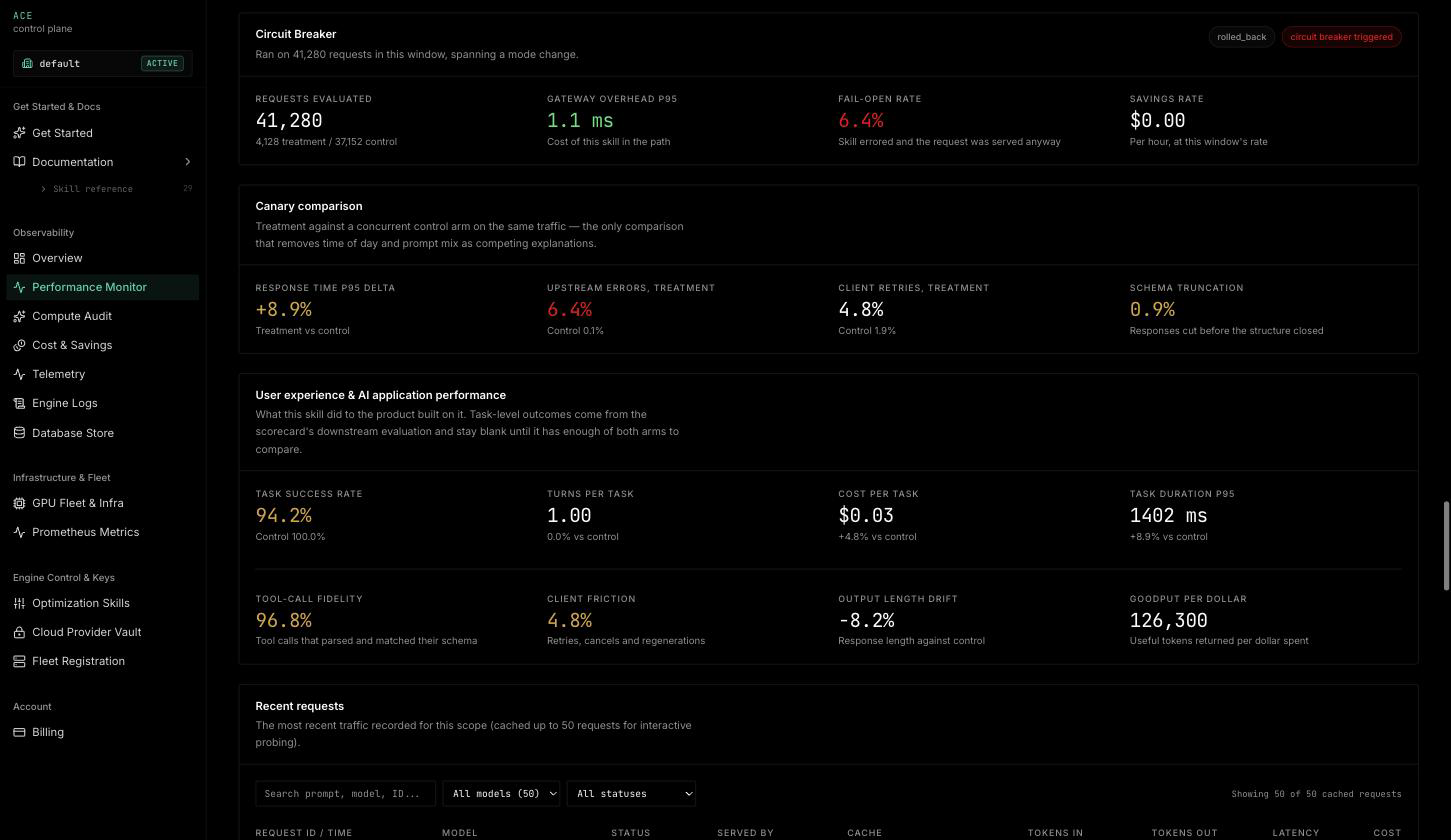
When tripped, the gateway atomically transitions the skill mode to rolled_back and routes 100% of subsequent traffic to the baseline provider path with zero dropped requests.
5. Live Production Dashboard & UI Integration
1. Real-Time Settings Badges & Healthy Rollout Analysis
Every skill toggle on the developer dashboard displays its active lifecycle mode, concurrent treatment vs. control metrics, and real-time health status:
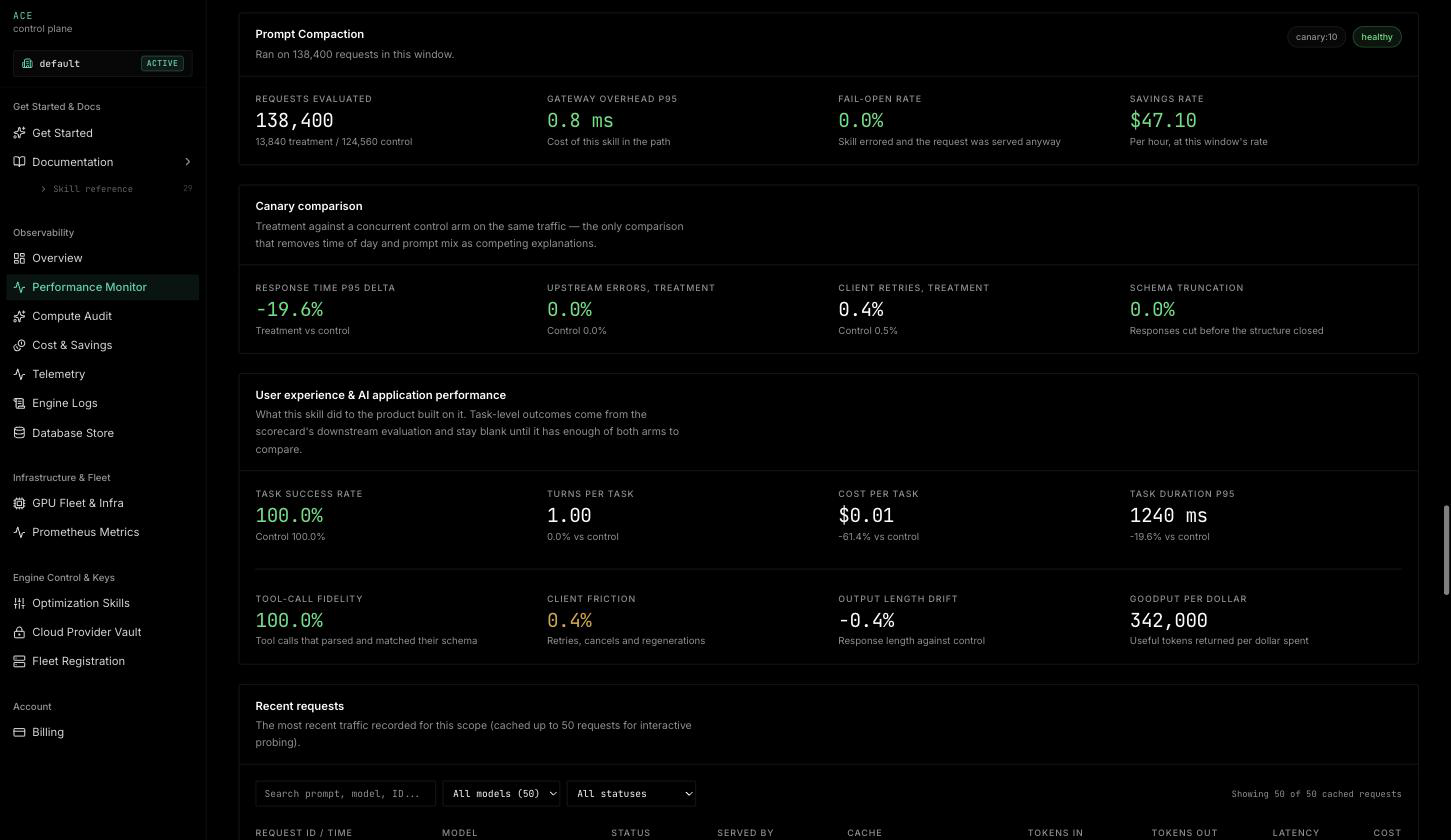
2. Automated Circuit Breaker in Action
When an internal invariant breaches the safety floor (e.g. fail-open rate spikes), the circuit breaker trips instantly, transitioning the mode to rolled_back and falling back to direct passthrough with sub-millisecond fail-safe response:
3. REST API for Automated CI/CD Promotions
Promote a skill to canary mode programmatically:
POST /api/v1/tenant/org_enterprise/skills/prompt_compaction/mode HTTP/1.1
Host: gateway.ace.internal
Content-Type: application/json

{
  "key_id": "dev_key_prod_01",
  "mode": "canary:10",
  "reason": "Promoting from shadow after 48h verified clean telemetry"
}
Response (200 OK):
{
  "status": "success",
  "skill_id": "prompt_compaction",
  "key_id": "dev_key_prod_01",
  "previous_mode": "shadow",
  "current_mode": "canary:10",
  "canary_percent": 10,
  "transition_id": "slc-7f9a12c84e01",
  "timestamp": "2026-08-30T00:00:00Z"
}
Summary & Next Steps
Embedded canary launches and automated circuit breakers give infrastructure teams the safety guarantees required to aggressively optimize inference costs without risking system uptime or error spikes.
- Part 1 (System Reliability & Errors): Solved via Embedded Canaries & Auto-Revert.
- Part 2 (ML Quality, Goodput & Task Dynamics): Read our companion post on Preventing ML Quality Regressions with Dual-Axis Performance Scorecards and Goodput.